
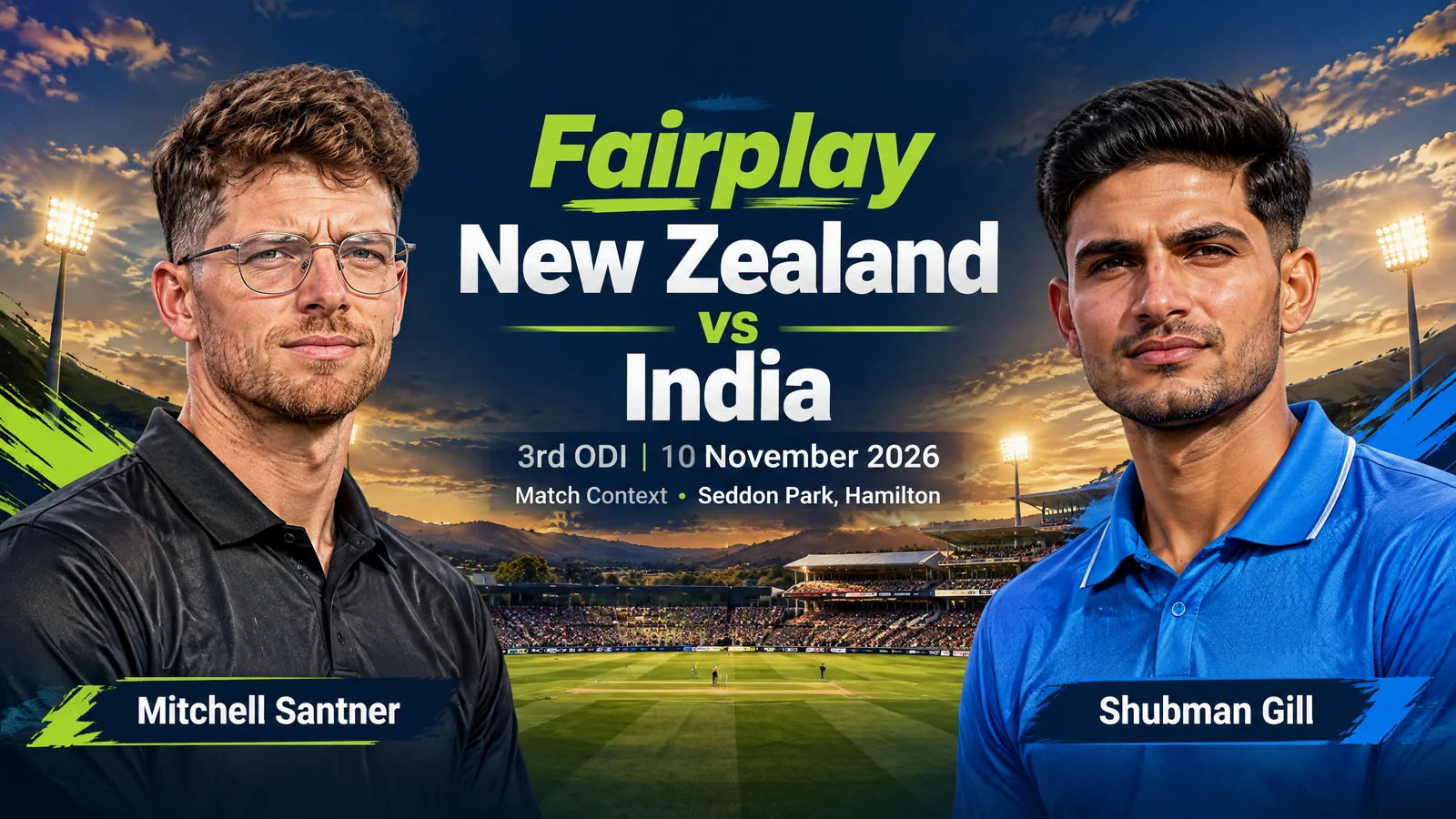
New Zealand and India’s third ODI is scheduled for 10 November 2026 at Seddon Park, Hamilton, with a 07:30 IST start. Rain affected the start, and conflicting status updates mean readers should refresh the live scorer rather than assume play has resumed or a result has been declared. This guide explains the pre-match 2–0 series position, what the completed Auckland and Wellington games reveal, and how to read a rain-adjusted scorecard without comparing unequal innings totals. It also separates Shubman Gill and Mitchell Santner’s captaincy appointments from the question of a confirmed playing XI, puts the Hamilton pitch report in its dated context, and examines New Zealand’s updated player availability. Practical checkpoints cover wickets, overs and revised targets, followed by the next ODI on 13 November and India’s planned leadership transition.
Fairplay New Zealand vs India covers the third ODI on Tuesday, 10 November 2026, at Seddon Park, Hamilton, scheduled for 07:30 IST, or 15:00 New Zealand local time. The BCCI fixture announcement and NZC summer schedule establish those details. Rain affected the start, but the source check around 11:53 IST found conflicting status messages, so this guide does not declare a result.
India entered this match 2–0 ahead, with Shubman Gill and Mitchell Santner the respective captains. This Fair Play match guide explains what the earlier games tell us, how interruptions change scorecard interpretation, and which squad updates matter. Use the Fairplay cricket analysis guide for the broader framework; the focus here is Hamilton’s specific match context.
Key Takeaways
- The third ODI is scheduled for 10 November at Seddon Park; rain affected the start and live status needs refreshing.
- India’s 2–0 lead describes the position entering this game, not its final outcome.
- Both completed ODIs used DLS, so raw innings totals alone cannot explain their results.
- Gill and Santner are the captains; squad availability and a confirmed playing XI are different things.
Hamilton’s scheduled start and the rain-status conflict
The fixture is a senior men’s ODI, not a T20I or Test. Its scheduled start converts to 02:00 UTC, and the exact BCCI third-ODI match page identifies the game. Keep the scheduled time separate from the actual start: an interrupted afternoon does not change which fixture this is.
At the research check, the fetched BCCI squad page described a delayed start. The Indian Express live report had reported a toss followed by further rain. Meanwhile, the rendered BCCI commentary page displayed a different outcome label without substantive scoring detail. That disagreement is not sufficient evidence to announce abandonment.
Refresh the live cricket score and look for a timestamp, innings total and explicit scorer status. A scheduled start, a reported toss and a final result are separate milestones. If the display remains inconsistent, retain the rain-affected description rather than filling the gap with an assumed outcome.
What India’s 2–0 lead actually rests on
India entered Hamilton leading the five-match series 2–0, as recorded by ESPNcricinfo’s second-ODI scorecard. A third completed victory would secure the series. That is the match’s starting stake, not a statement about what happened on 10 November.
In Auckland on 4 November, India won by five wickets under DLS. New Zealand made 185 in 40.2 overs; India finished on 143/5 in 22.4 overs. The BCCI first-ODI record names Anshul Kamboj as Player of the Match. The smaller winning total is a reminder to read the official adjusted result alongside the innings figures.
Wellington on 7 November offered an even sharper example. New Zealand were all out for 134, while India were 113/7 after 26 overs when rain intervened. India won by four runs under DLS, and Gurnoor Brar’s 4/30 earned him Player of the Match, according to the ESPNcricinfo scorecard. Those games establish a weather-affected series, not an automatic pattern for Hamilton.
Read the DLS target before comparing innings totals
A rain-adjusted scorecard needs more than the two headline totals. DLS accounts for the scoring resources available when interruptions alter an innings. Overs remaining and wickets lost matter, so the batting side’s position cannot be judged from its run total alone. This guide does not calculate a revised target: use the target or par figure published by the scorer.
A target is the score required to win; a displayed par score is a comparison point for the stated interruption. Neither should be copied from an earlier update and treated as permanently valid. Check which over and interruption the figure belongs to, and whether the match has resumed with a revised allocation or stopped for an official decision.
- Read the result line first, if an official result is available; note whether it specifies DLS.
- Check the latest innings total, wickets lost and overs completed against the timestamp.
- Find the revised target and remaining allocation, or the relevant par score if play is interrupted.
- Keep the published winning margin separate from the difference between the raw innings totals.
Wellington’s four-run DLS result cannot be reconstructed by subtracting 113 from 134. For the simpler scoring measures around an interrupted innings, the Fairplay cricket rates guide provides useful context; run rate alone does not replace the official adjustment.
Treat the Seddon Park pitch report as dated evidence
The strongest available Hamilton conditions evidence is a dated report, not a fresh pitch inspection. ESPNcricinfo’s 9 November preview said rain had limited preparation to approximately half a day and forced India to train indoors. It expected seam-friendly conditions and possible substantial interruptions.
That supports watching the new ball closely, but it does not establish exactly how the surface will behave. Once play is confirmed, distinguish movement through the air from movement after pitching. Then look at whether batters can leave deliveries safely, find singles and rotate strike without reaching away from the body. These are observation points, not a guaranteed description of the day's cricket.
A wet outfield and a difficult batting surface are also different issues: the former can delay play even before the latter is tested. Avoid attaching an unsupported average score or precise forecast to Seddon Park. The guide to analysing a cricket match helps connect conditions, phases and wickets without making the venue name do all the explanatory work.
India’s Wellington recovery is the useful batting reference
India’s previous chase showed the value of rebuilding after early damage. They slipped to 47/4 in Wellington; Shreyas Iyer made 30 from 46 balls and KL Rahul finished unbeaten on 26 from 38, according to the ESPNcricinfo second-ODI scorecard. Those figures describe a recovery, not a promise that the same players will repeat it.
If Hamilton produces another awkward start, watch the balance between preserving wickets and keeping the innings moving. A quiet passage can be constructive if it stops a collapse; the same passage may become costly when a revised target requires acceleration. The match situation, rather than a batter’s reputation, decides which reading fits.
Gill’s first-ball dismissal in Wellington was credited to Jacob Duffy in that scorecard. Keeping that attribution accurate matters when discussing the next new-ball contest. Use the cricket statistics section to separate a player’s completed innings from broader comparisons, and keep this match’s analysis conditional until its own deliveries provide evidence.
New Zealand’s recent reference points: Mitchell, Santner and the seamers
New Zealand’s second-ODI batting supplied two contrasting reference points. Daryl Mitchell scored 55 from 104 balls, while Santner contributed 31 from 38; Kyle Jamieson and Duffy each took three wickets in India’s innings. All four figures come from the Wellington scorecard, rather than a projected Hamilton performance.
Mitchell’s innings shows sustained occupation of the crease in that game, while Santner’s contribution provides a later-order comparison. If either bats here, judge the value of that approach against the wickets available and the current scoring requirement. A long innings and a quick contribution solve different problems; neither is automatically the better response in every phase.
For the bowlers, wickets deserve context too. Ask whether a spell broke a partnership, exposed the middle order or controlled scoring while another bowler attacked. The cricket players hub is a useful starting point for player context, but selection and roles for this ODI must come from a current team announcement.
Gill and Santner lead; availability still needs a separate check
Gill is India’s captain for ODIs one to three in the BCCI squad announcement. Santner is named captain of both New Zealand ODI groups in the ICC split-squad announcement. Those appointments establish the leadership pairing, but an announced squad is not the same document as a toss-confirmed XI.
The newer 9 November PTI update, published by The Hindu, added Kristian Clarke as cover for Blair Tickner, who faced a seven-day stand-down following his second-ODI substitution. It also said Matt Henry was advised to target the fourth ODI after concussion reassessment. Do not turn either update into an unsupported assertion that a player is in today’s XI.
The same report ruled Lockie Ferguson out of ODIs four and five while he recovered from a right-calf tear, and updated the earlier rotation plan by saying Henry and Jamieson were expected to remain for the fourth match. Keep each update attached to its match window; later-series availability is not automatically Hamilton availability.
Three checkpoints that make Hamilton easier to follow
Start with the new-ball phase, if play takes place. Record wickets alongside runs and overs rather than labelling a team ahead from one boundary or one dismissal. Wellington’s early pressure gives this checkpoint a concrete basis, but Hamilton still needs to be judged on its own play.
Next, watch the first sustained partnership after any early wickets. Notice whether singles return, whether the strike keeps moving and whether the field changes. This is more useful than treating every low-scoring over as a setback. A rebuilding pair can improve an innings without producing a boundary in every over.
Finally, restart your assessment after each interruption. Write down the latest allocation and target before evaluating the next passage. A strategy suited to the original innings length may no longer fit a shorter game. Keep these observations together in the cricket analysis section rather than mixing an old target, a new score and an unconfirmed status into one conclusion.
The next meeting is 13 November, with a leadership transition
There is no senior men’s India–New Zealand fixture scheduled for 11 November. The next meeting is the fourth ODI on Friday, 13 November, at Bay Oval, Tauranga, also described as Mount Maunganui, followed by the fifth there on 15 November. Both are scheduled for 07:30 IST and 15:00 local time in the BCCI itinerary and NZC schedule.
India’s announced captain for ODIs four and five is Iyer, not Gill. The tour also includes five T20Is and two Tests: Wellington on 19–23 November and Christchurch on 27 November–1 December. The ICC squad report explains the workload-management context alongside preparations for the 2027 ODI World Cup and World Test Championship.
Check upcoming cricket fixtures for the next match rather than carrying today’s captain pairing and squad assumptions forward unchanged. The ODI series position after Hamilton also needs an official result update before it becomes the starting point for a fourth-ODI guide.
Conclusion: keep the evidence and the live status together
Hamilton’s third ODI is best understood through three separate layers: the verified fixture, the completed games that gave India a 2–0 lead, and the latest rain-affected match status. Gill and Santner’s leadership is established; an outcome and a current XI should not be inferred from incomplete displays. Follow the revised target if interruptions alter play, judge performances in their innings context, and refresh the scorer before treating any status as final. That keeps this guide useful without pretending the unresolved parts are settled.
Questions, answered
When and where is New Zealand vs India’s third ODI?
The third ODI is scheduled for Tuesday, 10 November 2026, at Seddon Park, Hamilton. Its scheduled start is 07:30 IST, 15:00 New Zealand local time or 02:00 UTC. Rain affected the start, so the scheduled time should not be read as confirmation that play began.
Has the third ODI been abandoned?
This guide does not establish abandonment or a final result. Sources checked around 11:53 IST on 10 November displayed conflicting status messages. Refresh the live cricket score and look for an explicit, timestamped official decision rather than relying on an isolated page label.
Who are the captains for the Hamilton ODI?
Shubman Gill is India’s captain for the third ODI and Mitchell Santner is New Zealand’s captain. Their official appointments support that pairing. India’s announced captain for the fourth and fifth ODIs is Shreyas Iyer; future leadership should not be confused with today’s match.
Why did India win in Wellington with a lower innings total?
The second ODI ended with a four-run India victory under DLS after rain intervened. New Zealand made 134 and India were 113/7 in 26 overs. The adjusted result cannot be explained by subtracting the raw totals; use the scorer’s relevant DLS figures and official result.
Is there another India–New Zealand ODI on 11 November?
No senior men’s India–New Zealand match is scheduled for 11 November 2026. The next ODI is on 13 November at Bay Oval, followed by the fifth on 15 November at the same venue. Both have scheduled 07:30 IST starts.
Sources and evidence
- BCCI: India’s ODI and Test squads for New Zealand tour announced
Published 16 October 2026; official IST itinerary and Gill/Iyer captaincy windows. Retrieved 10 November 2026.
- NZC: International schedule 2026–27
Official venue, date and New Zealand local-time schedule. Retrieved 10 November 2026.
- BCCI: New Zealand vs India third-ODI match details
Exact official fixture identity for 10 November at Hamilton. Retrieved 10 November 2026; live status requires a fresh publication-time check.
- BCCI: Third-ODI squad page
Fetched version described a delayed start; rendered status conflicted. Retrieved 10 November 2026 around 11:51–11:52 IST. Not treated as a settled outcome or confirmed XI.
- Indian Express: India vs New Zealand third-ODI live report
10 November report, updated 10:00 IST, described a toss and further rain; captain-labelled line-ups appeared at 09:17 IST. Retrieved 10 November 2026; timing and status conflict retained, no XI reproduced.
- BCCI: Third-ODI commentary page
Rendered page showed No result without substantive scoring detail, conflicting with delay reports. Retrieved 10 November 2026 around 11:52 IST. Not used to declare abandonment.
- ESPNcricinfo: New Zealand vs India second-ODI full scorecard
Completed 7 November match: DLS result, innings totals, series position and cited player figures. Scorecard credits Gill’s dismissal to Duffy, overriding the conflicting preview attribution. Retrieved 10 November 2026.
- BCCI: New Zealand vs India first-ODI result
Completed 4 November Auckland match: five-wicket DLS result, innings totals and Anshul Kamboj’s Player of the Match award. Retrieved 10 November 2026.
- ESPNcricinfo: Third-ODI match preview
Dated 9 November conditions assessment and 10 November wet-outfield status. Pitch preparation and seam assessment are attributed reporting, not a fresh forecast or certain pitch behaviour. Retrieved 10 November 2026.
- ICC: New Zealand confirm split ODI squads for India series
Published 11 October 2026; Santner captaincy and workload-management context. Initial split-squad plan is qualified by the later PTI availability update. Retrieved 10 November 2026.
- PTI/The Hindu: New Zealand third-ODI squad update
9 November report on Clarke, Tickner, Henry, Ferguson and Jamieson. Distinguishes third-ODI cover from fourth/fifth-ODI availability. Retrieved 10 November 2026.
Read dated sources alongside the current match record. This briefing separates confirmed information from unannounced team decisions.