
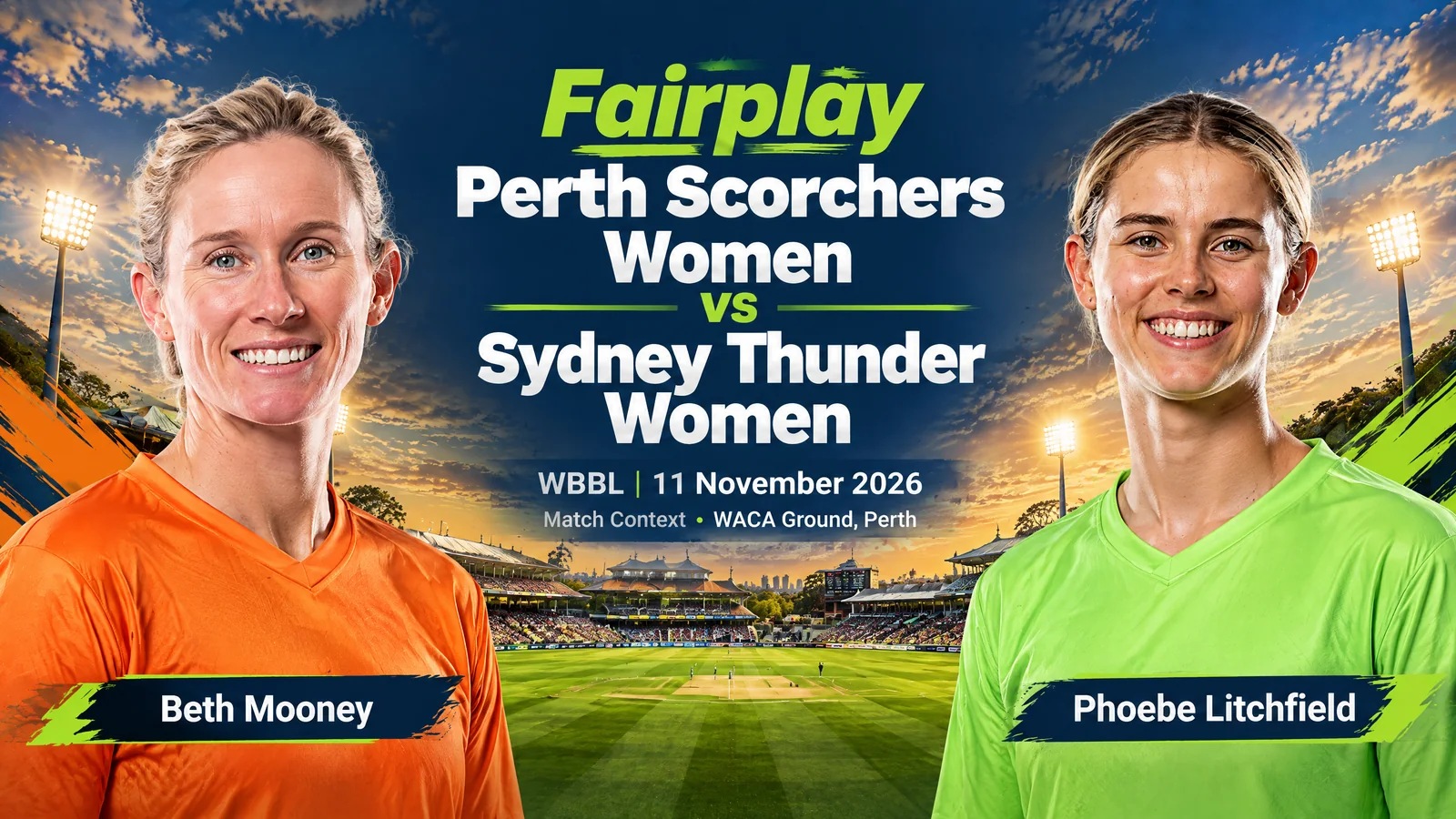
Perth Scorchers Women face Sydney Thunder Women at the WACA Ground on Wednesday, 11 November 2026, with first ball scheduled for 13:40 IST, equivalent to 16:10 in Perth. The fixture is Match 18 of Weber WBBL|12, not the earlier meeting between these teams on 5 November (official fixtures, Perth match notice). This Fairplay Perth Scorchers Women vs Sydney Thunder Women guide explains what to check before play and how to interpret the scorecard once the match begins. The useful starting points are current captaincy, the teams’ completed results through 8 November, and the contrasting batting and bowling contributions in their recent games. None establishes the forthcoming result. Use the Fairplay cricket analysis guide for the wider reading method, then apply the match-specific examples below. Treat season squads as background, not an announced playing XI, and keep every historical number attached to its date.
Key Takeaways
- The scheduled WACA start is 13:40 IST on 11 November (Perth fixture notice).
- Beth Mooney and Phoebe Litchfield are the confirmed season captains (Perth announcement, Thunder squad).
- Read the 5 November meeting as one completed example, and compare wickets, run control and batting tempo separately. Confirm the match-day team sheet before assigning roles.
1. Match 18 moves the contest from Sydney to the WACA
The confirmed fixture details are straightforward: Perth Scorchers Women against Sydney Thunder Women, WACA Ground, Perth, Wednesday 11 November 2026, in WBBL|12 Match 18. Both clubs’ schedules identify this match (Thunder fixtures, Scorchers fixtures). The competition match number should not be confused with Perth’s own season-game count.
For readers in India, use 13:40 IST. Perth’s notice gives 16:10 AWST, while Thunder’s November schedule gives the corresponding 19:10 AEDT (Perth notice, Thunder schedule notice). The upcoming cricket fixtures page is the natural place to organise your viewing schedule.
The previous encounter was at Drummoyne Oval in Sydney, so this is a change of venue (5 November report). That fact does not establish the prepared surface or how the ball will behave. Keep venue context separate from match-day observations rather than attaching an assumed scoring pattern to the WACA name.
2. Read recent form as a snapshot after 8 November
After their completed matches on 8 November, Perth had four wins from four games; Thunder had two wins and two defeats from four. This guide uses that dated snapshot, not an automatically refreshing league table (Perth–Stars report, Thunder–Sixers report).
Perth’s latest win came against Melbourne Stars at North Sydney Oval: Stars made 136 for six, and Perth won by six wickets with 30 balls remaining (completed match report). The margin describes that chase; it is not a measure of how comfortable the next contest must be.
Thunder’s latest result needs different context. In a rain-reduced derby, Sixers scored 162 for two from 16 overs. Thunder’s adjusted target was 168, and they were dismissed for 158 with three balls left, losing by nine runs (derby report). Do not compare that target directly with an uninterrupted innings. When using cricket statistics, retain the overs allocation and any target adjustment beside the result.
3. The 5 November meeting explains contributions, not inevitability
Perth won the teams’ 5 November encounter by 17 runs, making 183 for three before Thunder were dismissed for 166 in 19 overs (Cricket Australia match report). Those figures describe one direct meeting this season, not an all-time head-to-head record.
Mooney’s unbeaten 80 from 55 balls, including eight fours and one six, supplied a sustained batting contribution and earned her Player of the Match (Perth report). Reading beyond the top score means asking how long a batter stayed involved and how that innings connected with partners’ contributions.
Thunder’s chase contained several contributions: Litchfield made 34 from 18 balls, Heather Knight 27, Laura Harris 29 and Tahlia Wilson 25 (same completed-match report). The useful question is not whether those totals will recur, but how contributions combine across an innings. Use the cricket analysis hub to organise a comparison of partnerships, dismissals and scoring phases. A final total tells you the outcome; the sequence helps explain it.
4. Beth Mooney leads Perth; Phoebe Litchfield leads Thunder
Beth Mooney is Perth’s confirmed WBBL|12 captain. The club’s 30 October announcement says she takes over from Sophie Devine, who remains in the leadership group (captaincy announcement). Calling Devine the current Perth captain would therefore misstate this season’s leadership.
The transition does not erase shared experience. Perth’s season preview explains that Mooney and Devine had already collaborated on decisions, with Devine continuing to work with bowlers on the field (2026 Scorchers preview). This distinction helps readers separate the formal captaincy from the support provided by other senior players.
Phoebe Litchfield is Thunder’s confirmed season captain, entering her third season in charge according to the 28 October feature (Cricket Australia captain profile). Use the cricket players hub to keep names and roles straight while following the match. Season leadership is established background; the match-day team sheet remains the reference for who takes the field. When interpreting a bowling change, consider the game state before treating it as evidence about a captain’s whole approach.
5. Separate early breakthroughs from available bowling resources
Chloe Ainsworth’s 5 November spell offers a concrete new-ball example. She dismissed Georgia Voll with the first ball of Thunder’s innings, later removed Litchfield and finished with two wickets for 24 runs (Perth report). That is completed evidence, not a reason to expect another first-ball dismissal.
In the next scorecard, distinguish the timing of a breakthrough from the eventual bowling figures. An early dismissal changes which batters face the following deliveries; the completed spell tells you how the bowler performed across all their overs. Neither detail should disappear behind a single wickets column.
The season squads provide further context. Perth’s preview identifies Fatima Sana as a new signing, alongside overseas players Sophie Devine and Freya Kemp (Scorchers preview). Thunder’s captain feature discusses recruits Lauren Bell, Nadine de Klerk and Nicola Hancock (Thunder feature). These names describe available season resources, not confirmed participants in the return fixture. Wait for selection before building a comparison of the bowlers actually used.
6. Alana King shows why wickets and run control both matter
Alana King’s two recent spells demonstrate different kinds of bowling contribution. Against Thunder on 5 November, she took four wickets for 35 runs, including three wickets in the penultimate over (Perth match report). Against Stars on 8 November, she returned no wickets for 12 runs from four overs (Stars match report).
The wicketless spell should not be read as an absence of contribution. It recorded a low run return across her allocation, whereas the earlier spell supplied dismissals. A useful comparison keeps both dimensions visible instead of automatically valuing only the larger wickets figure.
Use the Fairplay cricket rates guide to understand scoring and concession rates alongside wickets. For this match, note a bowler’s overs, runs conceded, wickets and the stage of each spell. Then inspect the team’s position when those overs occurred. The Fair Play reading principle is simple: describe the contribution the figures support, rather than making every useful performance fit the same statistical shape.
7. Devine’s recent innings make tempo a question, not a forecast
The 5 November match contained an unusual batting decision: Devine voluntarily ended her innings on 42 from 39 balls after the 17th over. Her partnership with Mooney had added 85; Kemp then made 30 from 10 balls, and Perth scored 47 in the final three overs (Perth report, Cricket Australia report).
Read those events in sequence. The partnership, decision and closing burst describe how this particular innings developed. They do not establish that a batter should routinely end an innings in the same way, or that Perth will repeat the closing total at the WACA.
Against Stars three days later, Devine scored 55 from 24 balls, with eight fours and three sixes, reaching fifty in 21 deliveries (8 November report). That contrasting innings is a reminder to evaluate tempo in context. Track balls faced, partners available and the innings stage before attaching a permanent label to a player. For the return fixture, examine whether acceleration happens and how it is achieved; do not pre-fill the final overs with an earlier match’s numbers.
8. A season squad is not the match-day playing XI
Squad information answers who belongs to the season group, not who is selected for this game. Perth’s published WBBL|12 squad includes Mooney, Devine, King, Ainsworth, Amy Edgar, Sana and Kemp among its players (official squad in Perth’s report). Thunder’s current squad page includes Litchfield, Voll, Knight, Harris, Wilson, Bell and Darlington (official Thunder squad). These are squad examples, not a proposed XI.
There is also a fixture-specific distinction. Thunder’s November announcement contains a team group for the Sixers game, not the 11 November Perth game (squad announcement). Copying that group into this guide would confuse two different fixtures.
Before play, consult the live cricket score page for the released team sheet and toss information. Record the confirmed names first, then identify the batting and bowling roles shown during play. If a player from the season squad is absent, avoid supplying an explanation unless a reliable update provides one. Selection, captaincy and in-match usage are related, but they are not interchangeable facts.
9. Follow the scorecard in a repeatable sequence
A useful match note separates what happened from what you think it means. Start with the official match details, then add observations in innings order. The guide to analysing a cricket match explains the wider process; this Perth–Thunder sequence gives you a practical checklist.
Keep the first innings and chase in separate notes. If the target changes, record the revised target and available overs before discussing scoring pressure. Thunder’s 8 November derby is a recent example of why the adjustment belongs beside the totals, not in a footnote (completed derby report).
- Confirm the fixture, start time, selected XI and toss information. Do not carry names forward solely because they appeared in the previous match.
- During the opening phase, note runs and wickets together. Identify when a dismissal occurred, rather than looking only at the completed innings total.
- Through the middle overs, track partnerships and bowling spells. Ask whether a spell contributed through dismissals, limited scoring, or both; keep those observations distinct.
- In the closing overs, compare added runs with wickets lost and balls remaining. Describe the actual tempo without assuming a previous finishing burst will recur.
- After play, write one concise explanation supported by the scorecard. Separate the final result from the individual contributions that helped produce it.
10. Conclusion: let the new match supply its own evidence
This Fairplay Perth Scorchers Women vs Sydney Thunder Women guide is most useful as a reading framework, not an advance result. The fixture is scheduled for the WACA on 11 November at 13:40 IST (Perth fixture notice). Begin with the released team sheet, then follow early wickets, partnerships, bowling control and late-innings tempo.
Keep the recent examples in their proper place. They show why a sustained innings, a short acceleration, a wicket-taking spell and a restrictive spell deserve different explanations. Once the match starts, replace historical examples with its own scorecard evidence. That produces a clearer account of the cricket than treating recent form or one earlier meeting as a script.
Questions, answered
What time does Perth Scorchers Women vs Sydney Thunder Women start in India?
The scheduled first ball is 13:40 IST on Wednesday, 11 November 2026, at the WACA Ground in Perth. That corresponds to 16:10 AWST (Perth fixture notice).
Who are the current season captains?
Beth Mooney is Perth’s confirmed WBBL|12 captain, succeeding Sophie Devine (Perth announcement). Phoebe Litchfield is Thunder’s confirmed season captain (official squad). Check the match-day team sheet for the on-field line-up.
What happened in their 5 November meeting?
Perth won by 17 runs at Drummoyne Oval, scoring 183 for three before Thunder were dismissed for 166 in 19 overs (match report). This is one completed meeting, not an all-time head-to-head summary.
Do Perth’s four wins establish the next result?
No. Perth’s four wins from four matches describe its completed record after 8 November (Perth–Stars report). Thunder’s corresponding record was two wins and two defeats (derby report). Neither snapshot determines the 11 November outcome.
Does this guide list a confirmed playing XI?
No. It uses Perth’s published season squad and Thunder’s squad page as background, not a confirmed XI. Check the released match-day team sheet before assigning batting or bowling roles.
Sources and evidence
- Sydney Thunder official fixtures
Retrieved 10 November 2026; confirms WBBL|12 Match 18, teams, date and WACA venue. Schedule information is changeable.
- Perth Scorchers official fixtures
Retrieved 10 November 2026; independent confirmation of the 11 November WACA fixture. Schedule information is changeable.
- Perth Scorchers: statement win against Thunder
Retrieved 10 November 2026; report of the completed 5 November match, WBBL|12 squad and 11 November start notice. Its older season-record snapshot is not used.
- Cricket Australia: King and Mooney lead Scorchers
Retrieved 10 November 2026; completed 5 November Drummoyne Oval meeting and innings context, not an all-time head-to-head record.
- Perth Scorchers: Mooney to lead into new era
Retrieved 10 November 2026; official announcement displayed 30 October 2026 confirming Beth Mooney as WBBL|12 captain and Devine’s continuing leadership role.
- Cricket Australia: Scorchers WBBL|12 preview
Retrieved 10 November 2026; 29 October season preview supporting leadership continuity and season recruitment. Not a prepared-surface or match-day selection report.
- Cricket Australia: Litchfield embraces captaincy challenge
Retrieved 10 November 2026; 28 October feature confirming Litchfield’s third season as captain and Thunder recruitment.
- Sydney Thunder official WBBL squad
Retrieved 10 November 2026; current season squad and Litchfield’s captain label. A season squad is not the 11 November XI.
- Sydney Thunder: squad set for crosstown clash
Retrieved 10 November 2026; November schedule gives 19:10 AEDT for the Perth fixture. The selected group in this article concerns the Sixers fixture, not Perth on 11 November.
- Cricket Australia: Devine and Mooney keep Perth unbeaten
Retrieved 10 November 2026; completed 8 November match, Perth’s 4–0 record after that game, King’s restrictive spell and Devine’s innings. Not a live table.
- Cricket Australia: Sixers–Thunder derby report
Retrieved 10 November 2026; completed 8 November rain-reduced derby, adjusted target and Thunder’s 2–2 record after that game. Event date is used rather than an inconsistent extracted publication line.
Read dated sources alongside the current match record. This briefing separates confirmed information from unannounced team decisions.