
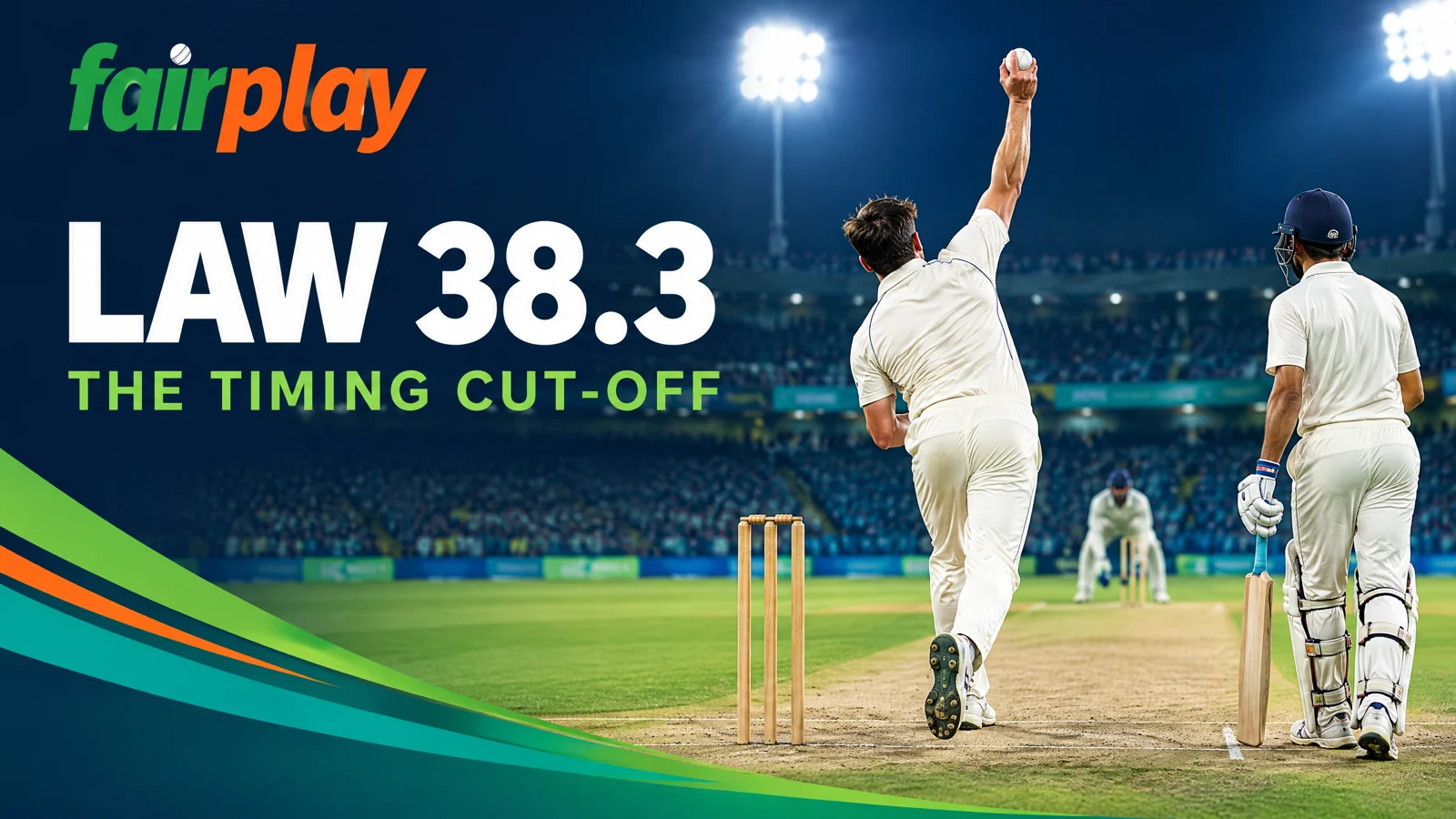
Fairplay explains fair play Law 38.3 timing, appeals, Dead ball calls and ball-count results when a non-striker leaves early.
Short answer: the Law 38.3 window stops at the highest point of the arm swing
A non-striker is liable under Law 38.3 only until the bowler’s arm reaches the highest point of the bowler’s normal bowling action in the delivery swing. The current MCC Law 38.3 says the window opens when the ball comes into play and closes at that point. Once the arm has reached it, the bowler can no longer dismiss the non-striker under this Law, even if the batter had left the ground earlier.
That cut-off is not a generic “after release” estimate. The Law uses the bowler’s normal action and the highest point of the arm in the delivery swing. A real decision therefore depends on the umpire’s judgment of the action and the moment the wicket was fairly broken; a cropped clip or a commentator’s label may not establish either fact. MCC’s 2023 clarification says the wording was changed to remove the mistaken idea that an earlier departure kept the batter liable after the action had progressed past the cut-off (MCC clarification).
- Start of window: the ball comes into play when the bowler starts the run-up, or starts the bowling action when there is no run-up, under Law 20.5.
- Cut-off: once the bowling arm reaches the highest point of its normal delivery swing, Law 38.3 no longer permits this special non-striker run out.
- Decision point: the non-striker must be out of their ground when the bowler breaks the wicket in the way Law 38.3 describes; an earlier departure alone is not a dismissal.
How to read the timing window without substituting “release” for the Law
Read the timing in two separate questions. First, was the non-striker out of their ground at any time after the ball came into play and before the arm reached its highest point? Second, when the wicket was broken by the bowler, was the non-striker out of their ground? Both parts matter in the current Law text. The high-point rule means the relevant cut-off arrives before a viewer should simply assume a conventional release frame.
The independent 2026 CricPulse explainer also treats this as a Run out rather than a separate dismissal type and describes the practical concern about acting before the normal delivery point. Its plain-English summary is useful context, but the live ruling must use the current MCC wording: highest point of the normal bowling action in the delivery swing. A simplified phrase such as “before release” cannot replace that wording where the timing is disputed.
If the ball is not delivered: appeal, Dead ball and the over count
Law 38.3.2 gives a specific sequence when the bowler has not delivered the ball. If there is an appeal, the umpire makes the Run out decision. If there is no appeal, or the decision is not out, the umpire must call and signal Dead ball as soon as possible. The final direction is clear: the ball does not count as one in the over (MCC Law 38.3).
For a no-delivery attempt that results in a dismissal after an appeal, the dismissal is recorded as Run out. Law 20 says a ball becomes dead when a batter is dismissed, deemed dead from the incident causing the dismissal (Law 20.1.1.3). Law 38.3.2 still places the attempted, undelivered ball outside the over count. The wicket is not credited to the bowler under Law 38.6.
- No delivery + appeal: umpire decides the Run out.
- No delivery + no appeal, or decision not out: call and signal Dead ball as soon as possible.
- No delivery under Law 38.3.2: the ball does not count in the over.
If the ball is delivered and appealed: two different branches
A delivered ball is not handled as the simple no-delivery Dead ball branch. Under Law 38.3.3, where the ball is delivered and there is an appeal, the umpire decides the Run out. If the non-striker is dismissed, the ball does not count as one in the over. The dismissal makes the ball dead from the decisive incident, and the dismissal remains Run out rather than a bowler-credited wicket (Law 20; Law 38.6).
If the non-striker is not dismissed, the ball remains in play and Law 21.6 applies. That cross-reference matters: where the ball is delivered and the non-striker is not dismissed under Law 38.3, Law 21.6 requires a No ball if the bowler broke the wicket in its stated period. A No ball does not count in the over, but a No-ball call does not itself make the ball dead (MCC Law 21.6, 21.13 and 21.16). Do not stop the live sequence, assign runs or choose the next striker from this guide alone.
- Delivered + appeal + out: Run out; the ball does not count.
- Delivered + appeal + not out: the ball remains in play; apply Law 21.6 rather than treating it as the no-delivery Dead ball case.
- A No ball under Law 21.6 does not count, but it is not automatically a Dead ball.
Labelled hypothetical cases: identify the branch before describing the result
These are fictional educational cases, not accounts of real matches, players or umpires. They assume the current MCC Law applies without a competition variation. They show why the delivery and appeal facts must be recorded separately from the high-point timing question.
The word “out” in a video caption is not enough. Start with the timing window, then establish whether the ball was delivered and whether an appeal was made. Only then use the appropriate Law 38.3 outcome. Where footage cannot show the high point, wicket-breaking moment, delivery or appeal, the honest conclusion is that the Law 38.3 result is not established from that footage alone.
| Hypothetical sequence | Law 38.3 result to test | Ball-status / count consequence |
|---|---|---|
| Before the arm reaches its normal high point, the bowler breaks the non-striker’s wicket without delivering. The batter is out of ground and the fielding side appeals. | Umpire decides the Run out; if the conditions are met, the non-striker is out Run out. | Ball is dead on dismissal; under 38.3.2 it does not count in the over. |
| The bowler does not deliver and breaks the wicket before the high point, but there is no appeal. | No Run out decision under the 38.3.2 appeal branch. | Umpire calls and signals Dead ball as soon as possible; it does not count. |
| The ball is delivered, an appeal follows and the non-striker is dismissed under 38.3. | Out Run out. | The ball does not count under 38.3.3; dismissal makes it dead. |
| The ball is delivered, an appeal follows and the non-striker is not dismissed. | Not out under 38.3. | Ball remains in play and Law 21.6 applies; do not apply the no-delivery Dead ball branch. |
| The bowler’s arm has already reached the normal high point before the attempted 38.3 wicket break. | The special Law 38.3 liability has closed, even if the batter left earlier. | No automatic Dead ball conclusion follows solely from that expiry; assess the actual later play under the applicable Laws. |
Runs, ends and scorecard language: keep the recorded event narrow
Where a Run out is actually given, Law 38.5 says the run in progress when the wicket is broken is not scored, while completed runs and applicable penalty runs stand. Law 18.8.2 says the same in general scoring terms. In the common undelivered Law 38.3 case there may be no running sequence to score, but do not assume that fact from a shorthand label; use the umpires’ and scorers’ record.
For related record-reading context, Fairplay’s complete-control run-out guide covers whether a wicket was fairly broken with control of the ball. Its scorecard guide explains how to read a dismissal alongside overs and extras. Neither replaces the separate Law 38.3 timing test.
Use the current Law first, then the competition’s current conditions
This guide uses the current MCC Law page checked on 19 October 2026 IST. MCC says its fourth edition of the 2017 Code came into force on 1 October 2026 (MCC announcement). That establishes the current Laws context, but a named match can be governed by playing conditions that modify or supplement the Laws.
For international series that start on or after 1 October 2026, the ICC says its updated Playing Conditions apply; ongoing series stay under the previous regulations (ICC). The current men’s ODI and T20I October 2026 documents reproduce the Law 38.3 structure and its delivered/not-delivered outcomes (ODI PDF; T20I PDF). The ICC conditions index also lists separate format, women’s and event-specific documents, so an ICC ODI or T20I PDF is not a universal domestic rulebook.
For club, school, domestic or franchise cricket, identify the organiser and the version of the conditions in force for that event. This guide has no named fixture and makes no claim that a particular local competition uses the ICC text. Fairplay’s Laws-versus-playing-conditions document check is the next route when the match is known.
- MCC’s current Law supplies the baseline here.
- For an international series, confirm its start date, format and applicable ICC document.
- For another competition, obtain the organiser’s current playing conditions before declaring a real incident settled.
A practical incident checklist and the next Fairplay routes
For a careful answer, write down the sequence in this order: when the ball came into play; the high point of the bowler’s normal action; the non-striker’s ground at wicket-breaking; whether the ball was delivered; whether an appeal was made; the umpire’s decision; and the over/scorecard entry. That order prevents a familiar label from silently replacing the controlling rule.
Use live cricket scores only for the displayed match state and source time, not as proof of a disputed action. Use cricket analysis for broader match context and cricket statistics for records. If an unusual dismissal changes a scorecard reading, the five-penalty-runs guide and stumped-from-a Wide or No ball guide explain nearby but different rules.
Questions, answered
When does the Law 38.3 non-striker run-out window close?
It closes once the bowler’s arm reaches the highest point of the bowler’s normal bowling action in the delivery swing. Law 38.3.1.1 says it is then no longer possible to dismiss the non-striker under Law 38.3, even if the batter had left the ground earlier. The current MCC wording, not a generic “release” label, controls the timing test.
Does a non-striker run out under Law 38.3 need an appeal?
Law 38.3.2 says that if the ball is not delivered and there is an appeal, the umpire makes the Run out decision. Law 38.3.3 uses the same decision step for a delivered ball and an appeal. In a real match, preserve the fielding-side appeal and the umpire’s decision rather than calling a batter out from video alone.
What happens if the bowler does not deliver the ball?
If there is an appeal, the umpire decides the Run out. If there is no appeal, or the decision is not out, the umpire calls and signals Dead ball as soon as possible. Law 38.3.2 says the ball does not count as one in the over. If a dismissal is given, it is Run out and the ball is dead from the incident causing the dismissal.
What happens if the bowler delivers the ball and the non-striker is not out?
With an appeal, Law 38.3.3 says the ball remains in play and Law 21.6 applies. Law 21.6 deals with a bowler breaking the wicket when delivering the ball and, in the stated circumstances, requires a No ball. A No ball does not count, but the call does not itself make the ball dead.
Is a Law 38.3 dismissal credited to the bowler?
No. It is recorded as Run out, and Law 38.6 says the bowler does not get credit for the wicket. If a Run out is given, the run in progress when the wicket was broken is not scored, while completed runs and applicable penalties stand, subject to the current Laws and match conditions.
Sources and evidence
- Marylebone Cricket Club — Law 38: Run out
Primary current Law text retrieved 19 October 2026 IST. Supports the Law 38.3 high-point cut-off, appeal procedures, no-delivery/delivered outcomes, scoring and bowler-credit rules.
- Marylebone Cricket Club — Law 20: Dead ball
Primary current Law text retrieved 19 October 2026 IST. Supports when the ball comes into play, when it becomes dead on dismissal, and the general Dead ball framework.
- Marylebone Cricket Club — Law 21: No ball
Primary current Law text retrieved 19 October 2026 IST. Supports Law 21.6, the Law 38.3.3 cross-reference, plus No-ball ball-status and count provisions.
- Marylebone Cricket Club — Law 18: Scoring Runs
Primary current Law text retrieved 19 October 2026 IST. Supports scoring treatment when a batter is Run out.
- Marylebone Cricket Club — clarification on non-strikers leaving early
Primary MCC clarification posted 19 January 2023 and retrieved 19 October 2026 IST. Explains the intended high-point interpretation and why the wording was clarified.
- International Cricket Council — Key changes across formats with new Playing Conditions
Primary ICC update dated 1 October 2026 and retrieved 19 October 2026 IST. Supports current series-start applicability from 1 October 2026.
- International Cricket Council — Men’s ODI Playing Conditions, October 2026
Official format-specific PDF retrieved 19 October 2026 IST. Reproduces the Law 38.3 structure for the listed international ODI conditions.
- International Cricket Council — Men’s T20I Playing Conditions, October 2026
Official format-specific PDF retrieved 19 October 2026 IST. Reproduces the Law 38.3 structure for the listed international T20I conditions.
- CricPulse — Mankading Explained: The Non-Striker Run-Out Rule in Cricket
Independent explanatory article dated 8 July 2026 and retrieved 19 October 2026 IST. Corroborates the practical classification as Run out; its simplified explanation is not used to override MCC’s precise high-point wording.
Scheduled facts and sourced history are separate from live match data. Source attribution does not imply affiliation with IPL, BCCI, ICC or players.