
FairPlay in cricket analysis can refer to a named performance-analysis software system, this portal’s evidence-led match explanations, or the sporting principle of fair play. The meaning depends on the product, website and question—not the name alone.
Key takeaways: A software name, a match-analysis method and sporting conduct are different things. Video helps explain recorded events; a scorecard supplies numerical evidence; the Spirit of Cricket describes how participants should behave. None of those establishes a guaranteed match result.
What does FairPlay mean when you are reading cricket analysis?
The phrase does not identify one universal cricket statistic or an official analytical formula. A reader searching for fair play cricket analysis might want coaching software, an explanation of a completed innings, or an assessment of sporting behaviour. Check what is being analysed before treating those answers as interchangeable.
This guide separates those meanings. For supplied match information and source-aware context, use the main Fair Play cricket analysis page. For the mechanics of reading runs, wickets and overs, use our scorecard analysis guide. Those pages answer different questions from a software product description.
The Australian vendor’s product is called The Cricket Analyst. It is a named software offering, not another name for every cricket score website. Our independent Fairplay portal is not that vendor and does not claim to provide its software, licence or athlete-management service.
The Cricket Analyst software: what is documented?
The Fair Play vendor describes The Cricket Analyst as a set of tools for analysing match, team, player and official performance. Its product page explains a reporting module linked to video, so coaches and players can move from a recorded event to the relevant footage. These are the vendor’s published descriptions, checked on 20 October 2026, rather than features we independently tested.
The product description also covers recording match details in a central database, storing video on local or network storage, and sharing statistics through a network or the cloud. It describes an Athlete Management System separately, including performance, training, medical and personal records. That broader administrative function is not the same thing as a public scorecard.
The vendor currently describes a Windows desktop application. Do not assume a browser-based information page gives access to that application, or that every mentioned module is included in one package. Product availability, supported environments and licence terms belong to the vendor’s current documentation, not to an illustrative blog cover.
How video analysis connects a match event to evidence
A video-analysis workflow connects an event record with the corresponding passage of footage. The analyst can then review what actually happened instead of relying only on memory or a summary score. A recorded wicket, for example, provides a starting point for examining the delivery and the batter’s response; it does not explain either of them automatically.
The vendor’s Analyzer page lists selection by players, clubs, events, zones and periods across multiple matches. It also describes replay, slow-motion and frame-by-frame controls, report-linked video and video export. The useful distinction is between finding a recorded moment and interpreting it: navigation tools help with the first task, while the second still requires a clear question and adequate evidence.
Video has limits. A single camera angle may not show the field setting, release point or a player’s communication. A clip that starts too late may omit context. Keep the event label and the source footage together, and state what cannot be seen rather than converting an incomplete view into certainty.
What statistical tracking and player management add
Statistical tracking organises recorded events so they can be compared under a stated definition. An analyst might group deliveries by player, innings period or a recorded event type. Those choices matter: a label such as ‘boundary’ is useful only if everyone knows which scoring events it includes and how incomplete records are handled.
The Analyzer documentation describes reporting against key performance indicators, or KPIs. A KPI is simply a defined measure used to answer a performance question. It should have an explicit unit, sample and selection rule. A measure built from one short innings should not quietly become a claim about a player’s whole career.
Player management may attach training information and administrative records to an athlete profile. Such information is different from public playing statistics, especially when medical or personal details are involved. This portal’s player profiles are public cricket-information pages, not a private coaching or medical-record system. For recorded statistical context, see cricket statistics.
Can you analyse a cricket match without specialist software?
Yes. Specialist software can organise video and event data, but the basic analytical task remains the same: identify the question, check the records and explain the evidence. A scorecard can support numerical observations even when video is unavailable. It cannot reveal conditions or causes that its fields do not contain.
Start with the match, format, innings and source update time. Keep team runs, wickets and overs together, and distinguish batter runs from extras. If you calculate a rate, name its denominator and handle partial overs as legal balls rather than a decimal fraction. Our guide to reading a scorecard works through those checks in detail.
A phase-based review asks another question: how did a completed innings unfold through its different periods? That needs evidence for the periods being compared, not just the final total. The T20 innings-phase analysis guide explains why a full-innings score cannot supply missing phase-by-phase events.
A practical review workflow: from question to conclusion
Consider a hypothetical coaching question: did a batter repeatedly mistime a particular type of delivery in the matches available for review? This is an illustrative workflow, not a finding about a real player or team. A software screen is not evidence that the pattern exists.
First define the delivery category and the visible behaviour being reviewed. Then identify the relevant match records and clips, including dates and format. Check the clips against their event labels, and retain cases that do not fit the proposed pattern. Explain how many usable examples were available before describing a trend.
Finish with a conclusion that matches the sample. If the footage or labels are incomplete, the answer may be that more evidence is needed. A useful review can expose uncertainty or correct an initial impression; it does not have to produce a confident recommendation from every set of records.
- Define one question and the events that would answer it.
- Identify the record source, match dates, format and available footage.
- Check labels against the clips and keep contrary examples.
- Describe the observed sample before making comparisons.
- Separate what was recorded, what was interpreted and what remains unknown.
Sporting fair play: conduct, umpires and the Spirit of Cricket
Sporting fair play is about conduct, not software. The MCC preamble makes respect central to the Spirit of Cricket: respect for captains, team-mates, opponents and the authority of umpires. It also stresses accepting decisions, self-discipline, positive conduct and acknowledging the opposition. The major responsibility rests with captains, but extends to other participants and, in junior cricket, coaches, teachers and parents.
Cricket Australia’s Spirit of Cricket explanation also describes umpire and captain responsibilities and discusses behaviour such as time-wasting and abusive conduct. An assessment of behaviour should use the applicable Laws, competition conditions and official findings. A community discussion—including a Quora answer—can express an opinion, but it is not the authority that defines a sanction.
Fair-play awards and conduct points have their own competition-specific criteria. They should not be treated as one universal cricket-analysis score or as a player’s batting or bowling statistic. For the broader sporting meaning, the Dutch fair-play values guide explains respect, integrity and related principles in Dutch.
Why odds commentary is a separate meaning
You may also encounter analysis wording on sites that discuss odds or match predictions. That wording does not establish that the site uses The Cricket Analyst, belongs to the software vendor, or measures sporting fair play. A shared name is not evidence of shared ownership or functionality.
An odds display is different from an event record. It does not document why a wicket fell or demonstrate that a future outcome is certain. Pitch, line-up or player-form statements still need their own supporting records; naming those topics is not a substitute for evidence.
This guide does not provide betting selections or outcome predictions. Our live score page shows supplied match information, while analysis explains the limits of what those records can support. Keep an observed event, an interpretation and an unverified future claim separate.
Use the page that answers your actual analysis question
For a definition of the phrase and the software-versus-conduct distinction, this is the relevant guide. For current match context, go to the Analysis page. For numerical interpretation, use the scorecard guide; for the sequence of a completed T20 innings, use the innings-phase guide. Keeping those purposes separate makes fairplay cricket analysis easier to follow.
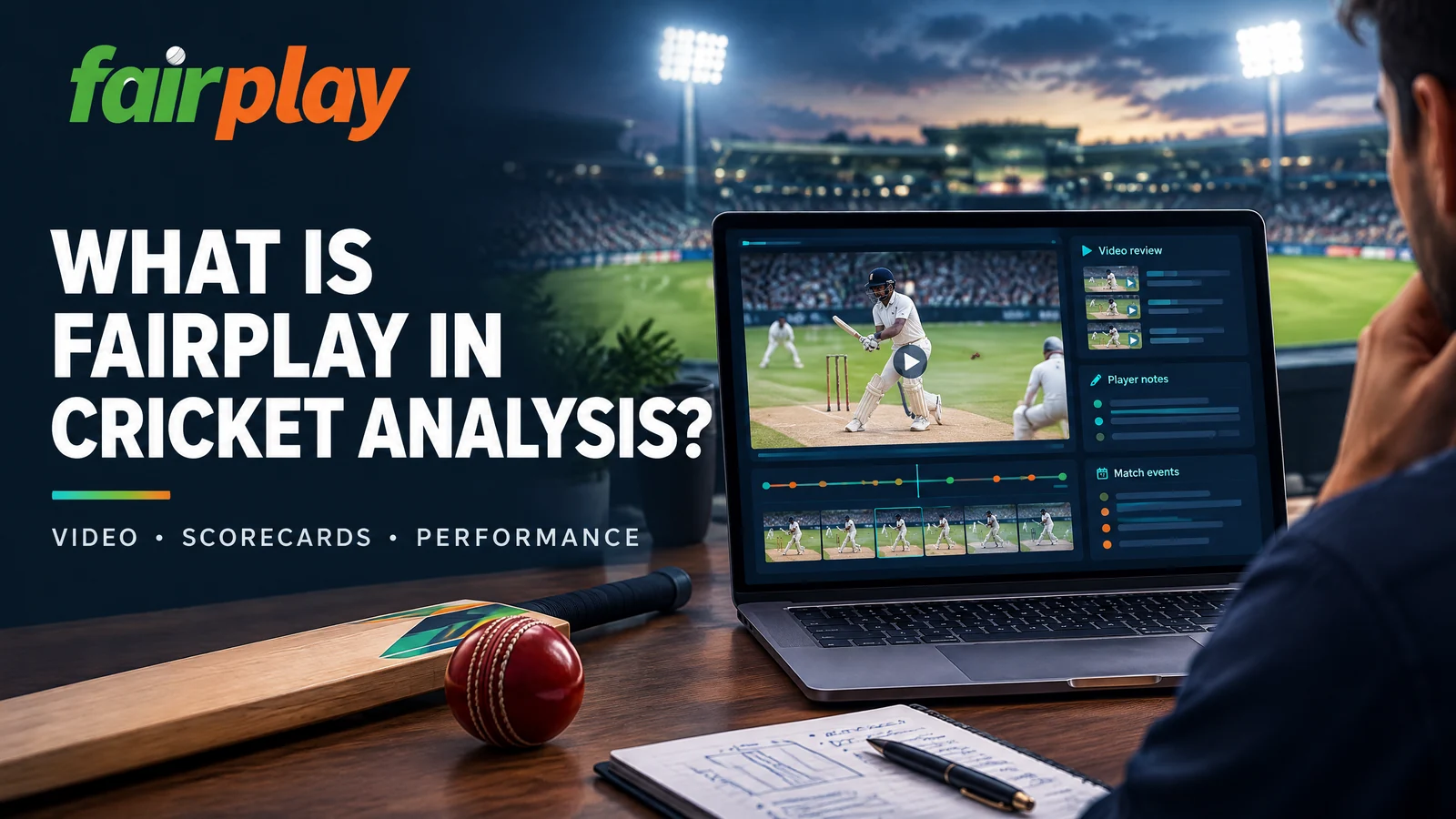
The cover is an original illustration of an analyst workstation. Its video panels and timeline convey the idea of reviewing match events; they are not a demonstration of a working product on this website. The portal remains an independent cricket-information publication, with source attribution rather than a claim of software-vendor affiliation.
Questions, answered
What is FairPlay in cricket analysis?
It can refer to a named performance-analysis software system, this portal’s match-analysis explanations, or sporting fair play. Identify the product, website and purpose before assuming those meanings describe the same service.
What does The Cricket Analyst software do?
The vendor describes tools connecting match records, statistics and video for reviewing match, team, player and official performance. Its product and Analyzer pages describe reporting, event selection and video review. Those are vendor-described capabilities, not features independently tested or supplied by this portal.
Is FairPlay cricket analysis the same as a match prediction?
No. Evidence-led analysis examines supplied records and explains their limits. A prediction concerns a future event. Video or scorecard observations do not make a future result certain, and this guide does not provide betting or outcome selections.
Are sporting fair-play points the same as batting or bowling statistics?
No. Sporting fair-play assessments concern behaviour and the criteria of a particular competition or award. Batting and bowling statistics describe recorded playing events. They should be identified and interpreted separately.
Does this website provide The Cricket Analyst application?
No. This independent Fairplay portal publishes cricket information and explanatory guides. It does not claim to be the Australian software vendor or provide its application, licence, private athlete database or medical-record service. The software-style cover is an original illustration, not a product screenshot.
Sources and evidence
- Fair Play Pty Ltd — The Cricket Analyst product description
Vendor description of performance tools, video-linked reports, match data and the separately described Athlete Management System. Checked 20 October 2026; not independently tested by this portal.
- Fair Play Pty Ltd — Analyzer module description
Vendor description of event selection, KPI reporting and video review controls. Checked 20 October 2026.
- MCC — The Preamble: The Spirit of Cricket
Official source for respect, accepting umpire decisions and participant responsibilities. Checked 20 October 2026.
- Cricket Australia — Spirit of Cricket
Corroborating sporting-conduct context. Competition-specific award criteria are not presented as a universal points system. Checked 20 October 2026.
Scheduled facts and sourced history are separate from live match data. Source attribution does not imply affiliation with IPL, BCCI, ICC or players.